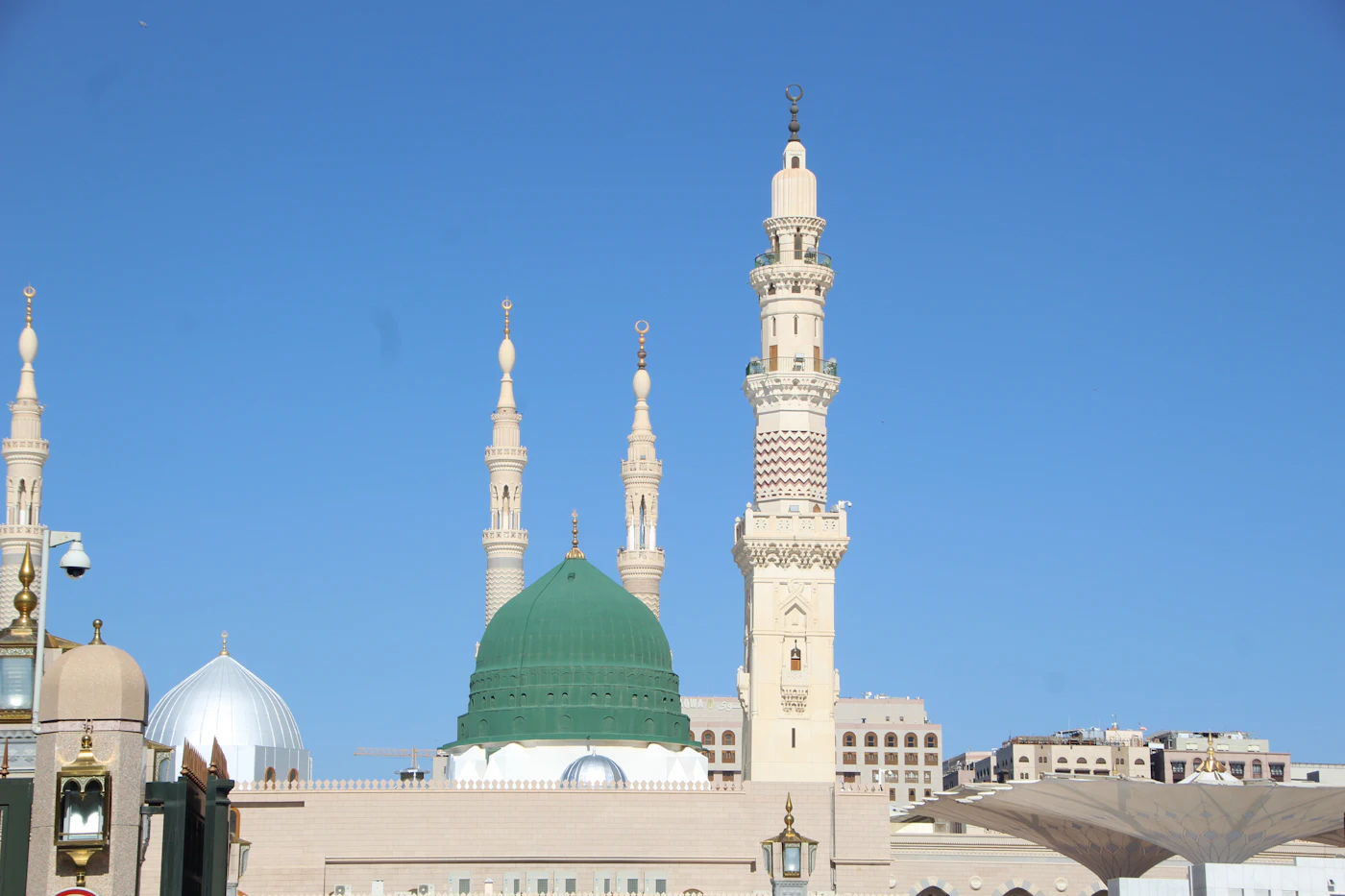
The life of Prophet Muhammad ﷺ year by year, told only from the Quran and authentic hadith. Where historians differ on dates, we say so.
Al-Masjid an-Nabawi · Photo: Unsplash
Timeline
c. 570—
Birth in Makkah
The Prophet ﷺ was born in Makkah, in the year commonly called the Year of the Elephant, around 570 CE; the exact date is disputed among historians. He himself said that Monday was the day he was born and the day revelation came to him. His father had died before his birth, and he grew up an orphan in the care of his grandfather and then his uncle. The Quran reminds him: did He not find you an orphan and give you refuge?
Have you not considered, [O Muḥammad], how your Lord dealt with the companions of the elephant?[1992]
Translator’s notes
[1992] i.e., the army under the command of Abrahah al-Ashram which was accompanied by a huge elephant and came with the intention of destroying the Kaʿbah at Makkah.
Abu Qatada al-Ansari (Allah be pleased with him) reported that the Messenger of Allah (ﷺ) was asked about his fasting. The Messenger of Allah (ﷺ) felt annoyed. Thereupon 'Umar (Allah be pleased with him) said:We are pleased with Allah as the Lord, with Islam as our Code of Life, with Muhammad as the Messenger and with our pledge (to you for willing and cheerful submission) as a (sacred) commitment. He was then asked about perpetual fasting, whereupon he said: He neither fasted nor did he break it, or he did not fast and he did not break it. He was then asked about fasting for two days and breaking one day. He (the Holy Prophet) said: And who has strength enough to do it? He was asked about fasting for a day and breaking for two days, whereupon he said: May Allah bestow upon us strength to do it. He was then asked about fasting for a day and breaking on the other, whereupon he said: That is the fasting of my brother David (peace be upon him). He was then asked about fasting on Monday, whereupon he said: It was the day on which I was born. on which I was commissioned with prophethood or revelation was sent to me, (and he further) said: Three days' fasting every month and of the whole of Ramadan every year is a perpetual fast. He was asked about fasting on the day of 'Arafa (9th of Dhu'I-Hijja), whereupon he said: It expiates the sins of the preceding year and the coming year. He was asked about fasting on the day of 'Ashura (10th of Muharram), whereupon be said: It expiates the sins of the preceding year. (Imam Muslim said that in this hadith there is a) narration of Imam Shu'ba that he was asked about fasting on Monday and Thursday, but we (Imam Muslim) did not mention Thursday for we found it as an error (in reporting).
Before prophethood he was known in Makkah for honesty and good character. He married Khadijah bint Khuwaylid, a noble and respected woman of Quraysh; historians commonly report this around 595 CE (ages and dates are reported differently). She supported him with her wealth and her heart, and she was the first to believe in his message. The Prophet ﷺ called her one of the best women of the world.
Evidence
وَوَجَدَكَ عَآئِلٗا فَأَغۡنَىٰ
And He found you poor and made [you] self-sufficient.
Narrated `Ali:I heard Allah's Messenger (ﷺ) saying (as below) Narrated `Ali: The Prophet (ﷺ) said, "The best of the world's women is Mary (at her lifetime), and the best of the world's women is Khadija (at her lifetime).
At about forty years of age he used to worship Allah alone in the cave of Hira. The angel Jibril came and said "Read!", and the first ayat of Surah al-Alaq were revealed. He returned trembling to Khadijah, who comforted him with the words: Allah will never disgrace you. After a pause in revelation, Surah al-Muddaththir was revealed, commanding him to rise and warn.
Narrated 'Aisha (the mother of the faithful believers):The commencement of the Divine Inspiration to Allah's Messenger (ﷺ) was in the form of good dreams which came true like bright daylight, and then the love of seclusion was bestowed upon him. He used to go in seclusion in the cave of Hira where he used to worship (Allah alone) continuously for many days before his desire to see his family. He used to take with him the journey food for the stay and then come back to (his wife) Khadija to take his food likewise again till suddenly the Truth descended upon him while he was in the cave of Hira. The angel came to him and asked him to read. The Prophet (ﷺ) replied, "I do not know how to read." The Prophet (ﷺ) added, "The angel caught me (forcefully) and pressed me so hard that I could not bear it any more. He then released me and again asked me to read and I replied, 'I do not know how to read.' Thereupon he caught me again and pressed me a second time till I could not bear it any more. He then released me and again asked me to read but again I replied, 'I do not know how to read (or what shall I read)?' Thereupon he caught me for the third time and pressed me, and then released me and said, 'Read in the name of your Lord, who has created (all that exists), created man from a clot. Read! And your Lord is the Most Generous." (96.1, 96.2, 96.3) Then Allah's Messenger (ﷺ) returned with the Inspiration and with his heart beating severely. Then he went to Khadija bint Khuwailid and said, "Cover me! Cover me!" They covered him till his fear was over and after that he told her everything that had happened and said, "I fear that something may happen to me." Khadija replied, "Never! By Allah, Allah will never disgrace you. You keep good relations with your kith and kin, help the poor and the destitute, serve your guests generously and assist the deserving calamity-afflicted ones." Khadija then accompanied him to her cousin Waraqa bin Naufal bin Asad bin 'Abdul 'Uzza, who, during the pre-Islamic Period became a Christian and used to write the writing with Hebrew letters. He would write from the Gospel in Hebrew as much as Allah wished him to write. He was an old man and had lost his eyesight. Khadija said to Waraqa, "Listen to the story of your nephew, O my cousin!" Waraqa asked, "O my nephew! What have you seen?" Allah's Messenger (ﷺ) described whatever he had seen. Waraqa said, "This is the same one who keeps the secrets (angel Gabriel) whom Allah had sent to Moses. I wish I were young and could live up to the time when your people would turn you out." Allah's Messenger (ﷺ) asked, "Will they drive me out?" Waraqa replied in the affirmative and said, "Anyone (man) who came with something similar to what you have brought was treated with hostility; and if I should remain alive till the day when you will be turned out then I would support you strongly." But after a few days Waraqa died and the Divine Inspiration was also paused for a while.
For the first years the call was mostly private. When Allah revealed "And warn your tribe of near kindred", the Prophet ﷺ climbed Safa and called the clans of Quraysh. They admitted they had only ever found him truthful, yet Abu Lahab rejected him, and Surah al-Masad was revealed. From then on the believers faced growing hostility.
Then declare what you are commanded[687] and turn away from the polytheists.[688]
Translator’s notes
[687] The implication is "Thereby you will distinguish or separate the disbelievers from the believers."
[688] Any who persist in association of others with Allāh.
Narrated Ibn `Abbas:When the Verse:--'And warn your tribe of near-kindred, was revealed, the Prophet (ﷺ) ascended the Safa (mountain) and started calling, "O Bani Fihr! O Bani `Adi!" addressing various tribes of Quraish till they were assembled. Those who could not come themselves, sent their messengers to see what was there. Abu Lahab and other people from Quraish came and the Prophet (ﷺ) then said, "Suppose I told you that there is an (enemy) cavalry in the valley intending to attack you, would you believe me?" They said, "Yes, for we have not found you telling anything other than the truth." He then said, "I am a warner to you in face of a terrific punishment." Abu Lahab said (to the Prophet) "May your hands perish all this day. Is it for this purpose you have gathered us?" Then it was revealed: "Perish the hands of Abu Lahab (one of the Prophet's uncles), and perish he! His wealth and his children will not profit him...." (111.1-5)
As persecution grew, a group of Muslims migrated to Abyssinia, where a just Christian king gave them protection. Historians report two migrations there; numbers and exact years are reported differently. The Quran comforted the believers that Allah's earth is spacious and that the patient will be given their reward without measure.
Say,[1345] "O My servants who have believed, fear your Lord. For those who do good in this world is good, and the earth of Allāh is spacious. Indeed, the patient will be given their reward without account [i.e., limit]."
Translator’s notes
[1345] The Prophet (ﷺ) is instructed to say on behalf of Allāh (subḥānahu wa taʿālā) to His believing servants.
And those who emigrated for [the cause of] Allāh after they had been wronged - We will surely settle them in this world in a good place; but the reward of the Hereafter is greater, if only they could know.
In the years before the Hijrah the Prophet ﷺ lost Khadijah and his uncle Abu Talib, which made the hardship heavier. He went to call the people of Ta'if, but they rejected him harshly. He later told Aishah that this day was among the hardest he faced. When the angel of the mountains offered to destroy them, he said: I hope Allah will bring from them people who worship Him alone.
And [mention, O Muḥammad], when We directed to you a few of the jinn, listening to the Qur’ān. And when they attended it, they said, "Listen attentively." And when it was concluded, they went back to their people as warners.
Narrated `Aisha:That she asked the Prophet (ﷺ) , 'Have you encountered a day harder than the day of the battle) of Uhud?" The Prophet (ﷺ) replied, "Your tribes have troubled me a lot, and the worse trouble was the trouble on the day of 'Aqaba when I presented myself to Ibn `Abd-Yalail bin `Abd-Kulal and he did not respond to my demand. So I departed, overwhelmed with excessive sorrow, and proceeded on, and could not relax till I found myself at Qarnath-Tha-alib where I lifted my head towards the sky to see a cloud shading me unexpectedly. I looked up and saw Gabriel in it. He called me saying, 'Allah has heard your people's saying to you, and what they have replied back to you, Allah has sent the Angel of the Mountains to you so that you may order him to do whatever you wish to these people.' The Angel of the Mountains called and greeted me, and then said, "O Muhammad! Order what you wish. If you like, I will let Al-Akh-Shabain (i.e. two mountains) fall on them." The Prophet (ﷺ) said, "No but I hope that Allah will let them beget children who will worship Allah Alone, and will worship None besides Him."
Allah took His servant by night from al-Masjid al-Haram to al-Masjid al-Aqsa, and then through the heavens, as the Quran states in Surah al-Isra and Surah an-Najm. The five daily prayers were made obligatory on this journey, as reported in the authentic hadith. Its exact date is disputed; it happened in Makkah some time before the Hijrah. We do not fix a date that is not proven.
Exalted[722] is He who took His Servant [i.e., Prophet Muḥammad (ﷺ)] by night from al-Masjid al-Ḥarām to al-Masjid al-Aqṣā,[723] whose surroundings We have blessed, to show him of Our signs. Indeed, He is the Hearing,[724] the Seeing.[725]
Translator’s notes
[722] Above any imperfection or failure to do as He wills.
[723] In Jerusalem.
[724] Who hears every sound, distinguishes every voice, understands every word, and accepts and responds to supplications.
[725] Who sees and understands all things apparent and unapparent, visible and invisible.
During the pilgrimage seasons, people from Yathrib (Madinah) met the Prophet ﷺ at Aqabah, accepted Islam and pledged their support. Ubadah ibn as-Samit narrated the pledge: not to associate anything with Allah, not to steal, not to commit zina, not to kill their children, not to slander, and not to disobey in what is good. This opened the way for the Hijrah to Madinah.
O Prophet, when the believing women come to you pledging to you that they will not associate anything with Allāh, nor will they steal, nor will they commit unlawful sexual intercourse, nor will they kill their children, nor will they bring forth a slander they have invented between their arms and legs,[1679] nor will they disobey you in what is right - then accept their pledge and ask forgiveness for them of Allāh. Indeed, Allāh is Forgiving and Merciful.
Translator’s notes
[1679] This is an allusion to pregnancy and childbirth, i.e., to falsely attribute a child (whether adopted or born of adultery) to a woman's husband.
Narrated 'Ubada bin As-Samit: who took part in the battle of Badr and was a Naqib (a person heading a group of six persons), on the night of Al-'Aqaba pledge: Allah's Apostle said while a group of his companions were around him, "Swear allegiance to me for: 1. Not to join anything in worship along with Allah. 2. Not to steal. 3. Not to commit illegal sexual intercourse. 4. Not to kill your children. 5. Not to accuse an innocent person (to spread such an accusation among people). 6. Not to be disobedient (when ordered) to do good deed." The Prophet (ﷺ) added: "Whoever among you fulfills his pledge will be rewarded by Allah. And whoever indulges in any one of them (except the ascription of partners to Allah) and gets the punishment in this world, that punishment will be an expiation for that sin. And if one indulges in any of them, and Allah conceals his sin, it is up to Him to forgive or punish him (in the Hereafter)." 'Ubada bin As-Samit added: "So we swore allegiance for these." (points to Allah's Apostle)
When Quraysh plotted to kill him, Allah permitted the Prophet ﷺ to emigrate. He left Makkah with Abu Bakr and they hid in a cave while the enemy searched for them; the Quran records his words: do not grieve, Allah is with us. He reached Madinah, where the Ansar welcomed him. The Islamic calendar was later counted from the year of the Hijrah.
If you do not aid him [i.e., the Prophet (ﷺ)] - Allāh has already aided him when those who disbelieved had driven him out [of Makkah] as one of two,[476] when they were in the cave and he [i.e., Muḥammad (ﷺ)] said to his companion, "Do not grieve; indeed Allāh is with us." And Allāh sent down His tranquility upon him and supported him with soldiers [i.e., angels] you did not see and made the word[477] of those who disbelieved the lowest,[478] while the word of Allāh[479] - that is the highest. And Allāh is Exalted in Might and Wise.
Translator’s notes
[476] The second was his companion, Abū Bakr.
[477] i.e., their claims and slogans.
[478] i.e., degraded and dishonored.
[479] "Lā ilāha ill-Allāh" ("There is no deity except Allāh").
And [remember, O Muḥammad], when those who disbelieved plotted against you to restrain you or kill you or evict you [from Makkah]. But they plan, and Allāh plans. And Allāh is the best of planners.
On reaching Madinah, the Prophet ﷺ and his companions built masjids, beginning at Quba and then the Masjid an-Nabawi in the heart of the city. The Quran praises a masjid founded on taqwa from the first day. The masjid became the centre of worship, learning and community life.
Do not stand [for prayer] within it - ever. A mosque founded on righteousness from the first day[504] is more worthy for you to stand in. Within it are men who love to purify themselves; and Allāh loves those who purify themselves.
In Madinah the Muslims prayed towards Bayt al-Maqdis (Jerusalem) for sixteen or seventeen months. The Prophet ﷺ longed to face the Kaaba, and Allah revealed: turn your face towards al-Masjid al-Haram. The first full prayer towards the Kaaba was Asr, and a companion told people in another masjid, who turned while still in prayer.
We have certainly seen the turning of your face, [O Muḥammad], toward the heaven, and We will surely turn you to a qiblah with which you will be pleased. So turn your face [i.e., yourself] toward al-Masjid al-Ḥarām.[53] And wherever you [believers] are, turn your faces [i.e., yourselves] toward it [in prayer]. Indeed, those who have been given the Scripture [i.e., the Jews and the Christians] well know that it is the truth from their Lord. And Allāh is not unaware of what they do.
Translator’s notes
[53] The Sacred Mosque in Makkah containing the Kaʿbah.
And thus We have made you a median [i.e., just] community that you will be witnesses over the people and the Messenger will be a witness over you. And We did not make the qiblah which you used to face except that We might make evident who would follow the Messenger from who would turn back on his heels.[52] And indeed, it is difficult except for those whom Allāh has guided. And never would Allāh have caused you to lose your faith [i.e., your previous prayers]. Indeed Allāh is, to the people, Kind and Merciful.
Narrated Al-Bara' (bin 'Azib): When the Prophet (ﷺ) came to Medina, he stayed first with his grandfathers or maternal uncles from Ansar. He offered his prayers facing Baitul-Maqdis (Jerusalem) for sixteen or seventeen months, but he wished that he could pray facing the Ka'ba (at Mecca). The first prayer which he offered facing the Ka'ba was the 'Asr prayer in the company of some people. Then one of those who had offered that prayer with him came out and passed by some people in a mosque who were bowing during their prayers (facing Jerusalem). He said addressing them, "By Allah, I testify that I have prayed with Allah's Messenger (ﷺ) facing Mecca (Ka'ba).' Hearing that, those people changed their direction towards the Ka'ba immediately. Jews and the people of the scriptures used to be pleased to see the Prophet (ﷺ) facing Jerusalem in prayers but when he changed his direction towards the Ka'ba, during the prayers, they disapproved of it. Al-Bara' added, "Before we changed our direction towards the Ka'ba (Mecca) in prayers, some Muslims had died or had been killed and we did not know what to say about them (regarding their prayers.) Allah then revealed: And Allah would never make your faith (prayers) to be lost (i.e. the prayers of those Muslims were valid).' " (2:143).
In the second year after the Hijrah, Allah made the fast of Ramadan obligatory, as it was prescribed for those before us, so that we may attain taqwa. Ramadan is the month in which the Quran was sent down as guidance for mankind. This is the commonly reported year; the obligation itself is stated in the Quran.
The month of Ramaḍān [is that] in which was revealed the Qur’ān, a guidance for the people and clear proofs of guidance and criterion. So whoever sights [the crescent of] the month,[66] let him fast it; and whoever is ill or on a journey - then an equal number of other days. Allāh intends for you ease and does not intend for you hardship and [wants] for you to complete the period and to glorify Allāh for that [to] which He has guided you; and perhaps you will be grateful.
At Badr a small and poorly equipped Muslim force met a much larger army of Quraysh. The believers called on their Lord for help, and Allah answered that He would support them with angels. Allah gave them victory when they were few and weak, and the Quran calls it the Day of Criterion.
And already had Allāh given you victory at [the battle of] Badr while you were weak [i.e., few in number]. Then fear Allāh; perhaps you will be grateful.
[Remember] when you were asking help of your Lord, and He answered you, "Indeed, I will reinforce you with a thousand from the angels, following one another."
And know that anything you obtain of war booty - then indeed, for Allāh is one fifth of it and for the Messenger[448] and for [his] near relatives[449] and the orphans, the needy, and the [stranded] traveler,[450] if you have believed in Allāh and in that which We sent down to Our Servant[451] on the day of criterion [i.e., decisive encounter] - the day when the two armies met [at Badr]. And Allāh, over all things, is competent.
Translator’s notes
[448] To be spent in Allāh's cause.
[449] The tribes of Banū Hāshim and Banū Muṭṭalib, who were not eligible for zakāh.
[450] The remaining four fifths are divided among the soldiers.
[451] Prophet Muḥammad (ﷺ).
Quraysh returned with a large army and the battle took place near Mount Uhud. The Muslims were winning at first, but some archers left their positions and the situation turned, and many companions were martyred. The Quran explains the lessons of obedience, patience and trust in Allah from this day. The Prophet ﷺ was wounded, yet stood firm.
And [remember] when you, [O Muḥammad], left your family in the morning to post the believers at their stations for the battle [of Uḥud] - and Allāh is Hearing and Knowing -
And Allāh had certainly fulfilled His promise to you when you were killing them [i.e., the enemy] by His permission until [the time] when you lost courage and fell to disputing about the order [given by the Prophet (ﷺ)] and disobeyed after He had shown you that which you love.[148] Among you are some who desire this world, and among you are some who desire the Hereafter. Then He turned you back from them [defeated] that He might test you. And He has already forgiven you, and Allāh is the possessor of bounty for the believers.
Many tribes gathered to attack Madinah, and the Muslims dug a trench to defend the city. The siege was very hard: the Quran describes eyes that swerved and hearts that reached the throats. Allah sent a wind and unseen forces against the confederates, and they withdrew without achieving their aim.
O you who have believed, remember the favor of Allāh upon you when armies came to [attack] you and We sent upon them a wind and armies [of angels] you did not see. And ever is Allāh, of what you do, Seeing.
[Remember] when they came at you from above you and from below you, and when eyes shifted [in fear], and hearts reached the throats, and you assumed about Allāh [various] assumptions.
And when the believers saw the companies, they said, "This is what Allāh and His Messenger had promised us, and Allāh and His Messenger spoke the truth." And it increased them only in faith and acceptance.
The Prophet ﷺ set out with his companions to perform Umrah, but Quraysh stopped them at Hudaybiyah. The companions pledged allegiance under the tree, and Allah said He was pleased with them. A peace treaty was agreed that seemed hard to some, yet Allah called it a clear victory, and many people entered Islam in the peace that followed.
Evidence
إِنَّا فَتَحۡنَا لَكَ فَتۡحٗا مُّبِينٗا
Indeed, We have given you, [O Muḥammad], a clear conquest[1507]
Translator’s notes
[1507] Ibn Masʿūd said, "You [people] consider the conquest to be that of Makkah, but we consider it to be the Treaty of al-Ḥudaybiyyah." Al-Bukhārī reported a similar quotation from al-Barā’ bin ʿĀzib. Although initially regarded by the companions as a setback, the treaty, in effect, served to promote the spread of Islām, which led to the conquest of Makkah two years later.
Certainly was Allāh pleased with the believers when they pledged allegiance to you, [O Muḥammad], under the tree, and He knew what was in their hearts, so He sent down tranquility upon them and rewarded them with an imminent conquest[1514]
Translator’s notes
[1514] That of Khaybar, which preceded the conquest of Makkah.
Certainly has Allāh showed to His Messenger the vision [i.e., dream] in truth. You will surely enter al-Masjid al-Ḥarām, if Allāh wills, in safety, with your heads shaved and [hair] shortened,[1517] not fearing [anyone]. He knew what you did not know and has arranged before that a conquest near [at hand].
Translator’s notes
[1517] i.e., having completed the rites of ʿumrah.
After Hudaybiyah the Muslims marched to Khaybar, a fortified town north of Madinah. Allah granted them victory there, and the Quran speaks of the many gains Allah promised the believers. Ali ibn Abi Talib carried the banner on the decisive day, as reported in authentic hadith.
Allāh has promised you much booty that you will take [in the future] and has hastened for you this [victory] and withheld the hands of people from you - that it may be a sign for the believers and [that] He may guide you to a straight path.
After Quraysh broke the treaty, the Prophet ﷺ marched to Makkah with a large army and entered it with very little fighting. He cleared the Kaaba of its 360 idols, reciting: truth has come and falsehood has vanished. He forgave his former enemies, and people entered Allah's religion in crowds, as Surah an-Nasr describes.
Evidence
إِذَا جَآءَ نَصۡرُ ٱللَّهِ وَٱلۡفَتۡحُ
When the victory of Allāh has come and the conquest,[2005]
Narrated `Abdullah:When the Prophet (ﷺ) entered Mecca on the day of the Conquest, there were 360 idols around the Ka`ba. The Prophet (ﷺ) started striking them with a stick he had in his hand and was saying, "Truth has come and Falsehood will neither start nor will it reappear.
Soon after the conquest of Makkah, the Muslims faced the tribes of Hawazin at Hunayn. Some were pleased with their large numbers, but at first they were driven back. Allah sent down His tranquillity on His Messenger and the believers, and forces they did not see, and the battle ended in victory — a lesson that victory comes from Allah, not from numbers.
Allāh has already given you victory in many regions and [even] on the day of Ḥunayn, when your great number pleased you, but it did not avail you at all, and the earth was confining for you with [i.e., in spite of] its vastness; then you turned back, fleeing.
Then Allāh sent down His tranquility upon His Messenger and upon the believers and sent down soldiers [i.e., angels] whom you did not see and punished those who disbelieved. And that is the recompense of the disbelievers.
In a time of great heat and hardship, the Prophet ﷺ led a large army north to Tabuk. The companions gave generously to equip it. There was no battle, but the expedition tested sincerity, and the Quran describes how Allah accepted the repentance of the three who stayed behind and then repented truthfully.
Allāh has already forgiven the Prophet and the Muhājireen and the Anṣār who followed him in the hour of difficulty after the hearts of a party of them had almost inclined [to doubt], and then He forgave them. Indeed, He was to them Kind and Merciful.
And [He also forgave] the three who were left alone [i.e., boycotted, regretting their error] to the point that the earth closed in on them in spite of its vastness[505] and their souls confined [i.e., anguished] them and they were certain that there is no refuge from Allāh except in Him. Then He turned to them so they could repent. Indeed, Allāh is the Accepting of Repentance,[506] the Merciful.
Translator’s notes
[505] Thus it seemed to them in their extreme distress.
[506] Refer to footnote in 2:37.
The Prophet ﷺ performed Hajj with a very large number of Muslims. In his sermon he declared that their blood, property and honour are sacred to one another, and asked: have I conveyed the message? The ayah was revealed that today Allah has perfected the religion and completed His favour.
Prohibited to you are dead animals,[241] blood, the flesh of swine, and that which has been dedicated to other than Allāh, and [those animals] killed by strangling or by a violent blow or by a head-long fall or by the goring of horns, and those from which a wild animal has eaten, except what you [are able to] slaughter [before its death], and those which are sacrificed on stone altars,[242] and [prohibited is] that you seek decision through divining arrows. That is grave disobedience. This day those who disbelieve have despaired of [defeating] your religion; so fear them not, but fear Me. This day I have perfected for you your religion and completed My favor upon you and have approved for you Islām as religion. But whoever is forced by severe hunger with no inclination to sin - then indeed, Allāh is Forgiving and Merciful.
Translator’s notes
[241] See footnote to 2:173.
[242] In the name of anything other than Allāh.
Narrated `Ikrima:Ibn `Abbas said: "Allah's Messenger (ﷺ) delivered a sermon on the Day of Nahr, and said, 'O people! (Tell me) what is the day today?' The people replied, 'It is the forbidden (sacred) day.' He asked again, 'What town is this?' They replied, 'It is the forbidden (Sacred) town.' He asked, 'Which month is this?' They replied, 'It is the forbidden (Sacred) month.' He said, 'No doubt! Your blood, your properties, and your honor are sacred to one another like the sanctity of this day of yours, in this (sacred) town (Mecca) of yours, in this month of yours.' The Prophet (ﷺ) repeated his statement again and again. After that he raised his head and said, 'O Allah! Haven't conveyed (Your Message) to them'. Haven't I conveyed Your Message to them?' " Ibn `Abbas added, "By Him in Whose Hand my soul is, the following was his will (Prophet's will) to his followers:--It is incumbent upon those who are present to convey this information to those who are absent Beware don't renegade (as) disbelievers (turn into infidels) after me, Striking the necks (cutting the throats) of one another.' "
In Rabi al-Awwal of 11 AH the Prophet ﷺ fell ill in the house of Aishah and passed away there; the month is agreed, the exact day is reported differently. His last words were: O Allah, the highest companion. Abu Bakr reminded the grieving companions of the ayah: Muhammad is only a messenger; messengers have passed before him. The message he left — the Quran and the Sunnah — remains.
Muḥammad is not but a messenger. [Other] messengers have passed on before him. So if he was to die or be killed, would you turn back on your heels [to unbelief]? And he who turns back on his heels will never harm Allāh at all; but Allāh will reward the grateful.
Muḥammad is not the father of [any] one of your men, but [he is] the Messenger of Allāh and seal [i.e., last] of the prophets. And ever is Allāh, of all things, Knowing.
Narrated `Aisha:When the Prophet (ﷺ) was healthy, he used to say, "No soul of a prophet is captured till he is shown his place in Paradise and then he is given the option." When death approached him while his head was on my thigh, he became unconscious and then recovered his consciousness. He then looked at the ceiling of the house and said, "O Allah! (with) the highest companions." I said (to myself), "Hence, he is not going to choose us." Then I realized that what he had said was the application of the narration which he used to mention to us when he was healthy. The last word he spoke was, "O Allah! (with) the highest companion."
Ten well-known companions, with what the Quran and authentic hadith say about them.
أبو بكر الصديق رضي الله عنه
Abu Bakr as-Siddiq
Abu Bakr was the closest friend of the Prophet ﷺ and among the first men to accept Islam. He was his companion in the cave during the Hijrah, mentioned in the Quran as "the second of two". The Prophet ﷺ said that if he were to take a khalil other than his Lord, he would have taken Abu Bakr, and named him the most beloved of men to him. After the Prophet ﷺ he became the first caliph.
If you do not aid him [i.e., the Prophet (ﷺ)] - Allāh has already aided him when those who disbelieved had driven him out [of Makkah] as one of two,[476] when they were in the cave and he [i.e., Muḥammad (ﷺ)] said to his companion, "Do not grieve; indeed Allāh is with us." And Allāh sent down His tranquility upon him and supported him with soldiers [i.e., angels] you did not see and made the word[477] of those who disbelieved the lowest,[478] while the word of Allāh[479] - that is the highest. And Allāh is Exalted in Might and Wise.
Translator’s notes
[476] The second was his companion, Abū Bakr.
[477] i.e., their claims and slogans.
[478] i.e., degraded and dishonored.
[479] "Lā ilāha ill-Allāh" ("There is no deity except Allāh").
Narrated Abu Sa`id Al-Khudri:Allah's Messenger (ﷺ) addressed the people saying, "Allah has given option to a slave to choose this world or what is with Him. The slave has chosen what is with Allah." Abu Bakr wept, and we were astonished at his weeping caused by what the Prophet (ﷺ) mentioned as to a Slave ( of Allah) who had been offered a choice, (we learned later on) that Allah's Messenger (ﷺ) himself was the person who was given the choice, and that Abu Bakr knew best of all of us. Allah's Messenger (ﷺ) added, "The person who has favored me most of all both with his company and wealth, is Abu Bakr. If I were to take a Khalil other than my Lord, I would have taken Abu Bakr as such, but (what relates us) is the Islamic brotherhood and friendliness. All the gates of the Mosque should be closed except the gate of Abu Bakr."
Narrated `Amr bin Al-As:The Prophet (ﷺ) deputed me to read the Army of Dhat-as-Salasil. I came to him and said, "Who is the most beloved person to you?" He said, " `Aisha." I asked, "Among the men?" He said, "Her father." I said, "Who then?" He said, "Then `Umar bin Al-Khattab." He then named other men.
Umar was known for his strength and his strictness in the truth. The Prophet ﷺ said that Shaytan never meets him on a path except that he takes another path, and that if there were inspired people in this Ummah, Umar would be one of them. He was named among the most beloved men to the Prophet ﷺ after Abu Bakr. He became the second caliph and was known for justice.
Sa'd b. Waqqas reported that Umar sought permission from Allah's Messenger (ﷺ) to visit him when some women of the Quraish were busy in talking with him and raising their voices above his Voiee. When'Umar sought permission they stood up and went hurriedly behind the curtain. Allah's Messenger (ﷺ) gave him permission smilingly. Thereupon 'Umar said:Allah's Messenger, may Allah keep you happy all your life. Then Allah's Messenger (ﷺ) said: I wonder at these women who were with me and no sooner did they hear your voice, they immediately went behind the curtain. Thereupon 'Umar said: Allah's Messenger, you have more right that they should fear you. Then Umar (addressing the women) said: O ye enemies of yourselves, do you fear me and fear not the Messenger of Allah (ﷺ)? They said: Yes, you are harsh and strict as compared to the Messenger of Allah (ﷺ). Thereupon, Allah's Messenger (maypeace be upon him) said: By Him in Whose Hand is my life, if satan would encounter you in the way he would certainly take a different way from that of yours.
A'isha reported Allah's Messenger (ﷺ) as saying:There had been among the people before you inspired persons and if there were any such among my Umma Umar b. Khattab would be one of them. Ibn Wahb explained the word Muhaddathun as those who receive hint from the High (Mulhamun).
Narrated `Amr bin Al-As:The Prophet (ﷺ) deputed me to read the Army of Dhat-as-Salasil. I came to him and said, "Who is the most beloved person to you?" He said, " `Aisha." I asked, "Among the men?" He said, "Her father." I said, "Who then?" He said, "Then `Umar bin Al-Khattab." He then named other men.
Uthman was known for his modesty and generosity. The Prophet ﷺ said: should I not show modesty to a man before whom even the angels are modest? He spent much of his wealth for the Muslims. He became the third caliph, and under him the Quran was compiled into a single standard copy sent to the regions.
`Aisha reported:Allah's Messenger (ﷺ) was lying in the bed in my apartment with his thigh uncovered and Abu Bakr sought permission to enter. It was given to him and he conversed in the same very state (the Prophet's thigh or shank uncovered). Then `Umar sought permission for entering and it was given to him and he conversed in that very state. Then `Uthman sought permission to enter; Allah's Messenger (ﷺ) sat down and he set right his clothes. Muhammad (one of the narrators) said: I do not say that it happened on the same day. He (`Uthman) then entered and conversed and as he went out, `Aisha said: Abu Bakr entered and you did not stir and did not observe much care (in arranging your clothes), then `Umar entered and you did not stir and did not arrange your clothes, then `Uthman entered and you got up and set your clothes right, so he (ﷺ) said: Should I not show modesty to one whom even the Angels show modesty.
Ali was the cousin of the Prophet ﷺ, raised in his house, and among the first to accept Islam as a boy. He married Fatimah, the Prophet's daughter. The Prophet ﷺ said to him: you are to me in the position of Harun to Musa, except that there is no prophet after me. He was known for knowledge and bravery, and became the fourth caliph.
Amir b Sa'd b. Abi Waqqas reported (on the authority of his father that Allah's Messenger (ﷺ) addressing 'Ali said:You are in the same position with relation to me as Aaron (Harun) was in relation to Moses but with (this explicit difference) that there is no prophet after me. Sa'd said: I had an earnest desire to hear it directly from Sa'd, so I met him and narrated to him what (his son) Amir had narrated to me, whereupon he said: Yes, I did hear it. I said: Did you hear it yourself? Thereupon he placed his fingers upon his ears and said: Yes, and if not, let both my ears become deaf.
Khadijah was the first wife of the Prophet ﷺ and the first person to believe in him. When the first revelation came, she comforted him and took him to Waraqah ibn Nawfal. Jibril brought her greetings of peace from her Lord and good news of a house in Paradise. The Prophet ﷺ said the best of the women of her time was Khadijah.
Narrated Abu Huraira: Gabriel came to the Prophet (ﷺ) and said, "O Allah's Messenger (ﷺ)! This is Khadija coming to you with a dish having meat soup (or some food or drink). When she reaches you, greet her on behalf of her Lord (i.e. Allah) and on my behalf, and give her the glad tidings of having a Qasab palace in Paradise wherein there will be neither any noise nor any fatigue (trouble) . "
Narrated `Ali:I heard Allah's Messenger (ﷺ) saying (as below) Narrated `Ali: The Prophet (ﷺ) said, "The best of the world's women is Mary (at her lifetime), and the best of the world's women is Khadija (at her lifetime).
Narrated 'Aisha (the mother of the faithful believers):The commencement of the Divine Inspiration to Allah's Messenger (ﷺ) was in the form of good dreams which came true like bright daylight, and then the love of seclusion was bestowed upon him. He used to go in seclusion in the cave of Hira where he used to worship (Allah alone) continuously for many days before his desire to see his family. He used to take with him the journey food for the stay and then come back to (his wife) Khadija to take his food likewise again till suddenly the Truth descended upon him while he was in the cave of Hira. The angel came to him and asked him to read. The Prophet (ﷺ) replied, "I do not know how to read." The Prophet (ﷺ) added, "The angel caught me (forcefully) and pressed me so hard that I could not bear it any more. He then released me and again asked me to read and I replied, 'I do not know how to read.' Thereupon he caught me again and pressed me a second time till I could not bear it any more. He then released me and again asked me to read but again I replied, 'I do not know how to read (or what shall I read)?' Thereupon he caught me for the third time and pressed me, and then released me and said, 'Read in the name of your Lord, who has created (all that exists), created man from a clot. Read! And your Lord is the Most Generous." (96.1, 96.2, 96.3) Then Allah's Messenger (ﷺ) returned with the Inspiration and with his heart beating severely. Then he went to Khadija bint Khuwailid and said, "Cover me! Cover me!" They covered him till his fear was over and after that he told her everything that had happened and said, "I fear that something may happen to me." Khadija replied, "Never! By Allah, Allah will never disgrace you. You keep good relations with your kith and kin, help the poor and the destitute, serve your guests generously and assist the deserving calamity-afflicted ones." Khadija then accompanied him to her cousin Waraqa bin Naufal bin Asad bin 'Abdul 'Uzza, who, during the pre-Islamic Period became a Christian and used to write the writing with Hebrew letters. He would write from the Gospel in Hebrew as much as Allah wished him to write. He was an old man and had lost his eyesight. Khadija said to Waraqa, "Listen to the story of your nephew, O my cousin!" Waraqa asked, "O my nephew! What have you seen?" Allah's Messenger (ﷺ) described whatever he had seen. Waraqa said, "This is the same one who keeps the secrets (angel Gabriel) whom Allah had sent to Moses. I wish I were young and could live up to the time when your people would turn you out." Allah's Messenger (ﷺ) asked, "Will they drive me out?" Waraqa replied in the affirmative and said, "Anyone (man) who came with something similar to what you have brought was treated with hostility; and if I should remain alive till the day when you will be turned out then I would support you strongly." But after a few days Waraqa died and the Divine Inspiration was also paused for a while.
Aishah, daughter of Abu Bakr, was a wife of the Prophet ﷺ and one of the greatest scholars among the companions; many hadith are narrated through her. The Prophet ﷺ named her the most beloved of people to him, and told her that Jibril was sending her greetings. He said her virtue over other women is like the virtue of tharid over other food. Allah declared her innocence in the Quran (Surah an-Nur).
Indeed, those who came with falsehood[978] are a group among you. Do not think it bad for you; rather, it is good for you. For every person among them is what [punishment] he has earned from the sin, and he who took upon himself the greater portion thereof[979] - for him is a great punishment [i.e., Hellfire].
Translator’s notes
[978] Referring to the incident when the Prophet's wife ʿĀ’ishah was falsely accused by the hypocrites.
[979] i.e., ʿAbdullāh bin ʿUbayy, leader of the hypocrites.
Narrated Abu Musa Al-Ash`ari:Allah's Messenger (ﷺ) said, "Many amongst men attained perfection but amongst women none attained the perfection except Mary, the daughter of `Imran and Asiya, the wife of Pharaoh. And the superiority of `Aisha to other women is like the superiority of Tharid (i.e. an Arabic dish) to other meals."
Narrated Abu Salama:`Aisha said, "Once Allah's Messenger (ﷺ) said (to me), 'O Aish (`Aisha)! This is Gabriel greeting you.' I said, 'Peace and Allah's Mercy and Blessings be on him, you see what I don't see' " She was addressing Allah 's Apostle.
Narrated `Amr bin Al-As:The Prophet (ﷺ) deputed me to read the Army of Dhat-as-Salasil. I came to him and said, "Who is the most beloved person to you?" He said, " `Aisha." I asked, "Among the men?" He said, "Her father." I said, "Who then?" He said, "Then `Umar bin Al-Khattab." He then named other men.
Fatimah was the beloved daughter of the Prophet ﷺ and the wife of Ali. The Prophet ﷺ said: my daughter is a part of me; what troubles her troubles me. Before his passing he told her she would be the first of his family to follow him, and that she would be the leader of the women of Paradise. She passed away a few months after him.
Miswar b. Makhramali reported that he heard Allah's Messenger (ﷺ) say, as he sat on the pulpit:The sons of Hisham b. Mughira have asked my permission to marry their daughter with 'Ali b. Abi Talib (that refers to the daughter of Abu Jahl for whom 'All had sent a proposal for marriage). But I would not allow them, I would not allow them, I would not allow them (and the only alternative possible is) that 'Ali should divorce my daughter (and then marry their daughter), for my daughter is part of me. He who disturbs her in fact disturbs me and he who offends her offends me.
Narrated `Aisha:Once Fatima came walking and her gait resembled the gait of the Prophet (ﷺ) . The Prophet (ﷺ) said, "Welcome, O my daughter!" Then he made her sit on his right or on his left side, and then he told her a secret and she started weeping. I asked her, "Why are you weeping?" He again told her a secret and she started laughing. I said, "I never saw happiness so near to sadness as I saw today." I asked her what the Prophet (ﷺ) had told her. She said, "I would never disclose the secret of Allah's Messenger (ﷺ)." When the Prophet (ﷺ) died, I asked her about it. She replied. "The Prophet (ﷺ) said: 'Every year Gabriel used to revise the Qur'an with me once only, but this year he has done so twice. I think this portends my death, and you will be the first of my family to follow me.' So I started weeping. Then he said. 'Don't you like to be the chief of all the ladies of Paradise or the chief of the believing women? So I laughed for that."
Bilal was an enslaved man in Makkah who accepted Islam early and stayed firm under severe persecution. Abu Bakr freed him, and Umar used to say: Abu Bakr is our master, and he freed our master — meaning Bilal. He became the muadhdhin of the Prophet ﷺ. The Prophet ﷺ said he heard Bilal's footsteps ahead of him in Paradise, because he prayed after every wudu.
Narrated Abu Huraira:At the time of the Fajr prayer the Prophet (ﷺ) asked Bilal, "Tell me of the best deed you did after embracing Islam, for I heard your footsteps in front of me in Paradise." Bilal replied, "I did not do anything worth mentioning except that whenever I performed ablution during the day or night, I prayed after that ablution as much as was written for me."
Khalid was a skilled commander of Quraysh who fought against the Muslims at first and later accepted Islam. At the battle of Mu'tah, after three commanders were martyred one after another, he took the banner and Allah granted the Muslims a way through. The Prophet ﷺ, with tears in his eyes, called him one of the swords of Allah.
Narrated Anas:The Prophet (ﷺ) had informed the people about the death of Zaid, Ja`far and Ibn Rawaha before the news of their death reached them. He said with his eyes flowing with tears, "Zaid took the flag and was martyred; then Ja`far took the flag and was martyred, and then Ibn Rawaha took the flag and was martyred. Finally the flag was taken by one of Allah's Swords (i.e. Khalid bin Al-Walid) and Allah gave them (i.e. the Muslims) victory."
Mus'ab was a young man of comfort in Makkah who left wealth behind for Islam. The Prophet ﷺ sent him to Madinah before the Hijrah to teach the Quran, and many people there accepted Islam through him (as historians report). He was martyred at Uhud, and Abd ar-Rahman ibn Awf wept remembering that only a small sheet could be found to shroud him. His life shows giving up the world for Allah.
Among the believers are men true to what they promised Allāh. Among them is he who has fulfilled his vow [to the death], and among them is he who awaits [his chance]. And they did not alter [the terms of their commitment] by any alteration -
Narrated Sa`d from his father:Once the meal of `Abdur-Rahman bin `Auf was brought in front of him, and he said, "Mus`ab bin `Umair was martyred and he was better than I, and he had nothing except his Burd (a black square narrow dress) to be shrouded in. Hamza or another person was martyred and he was also better than I and he had nothing to be shrouded in except his Burd. No doubt, I fear that the rewards of my deeds might have been given early in this world." Then he started weeping.